Computing Ray-Tracing Thicknesses
You can compute thickness values from the mesh of a single, closed 3D shape using a directional method known as normal ray tracing. In this method, a ray is passed normal to the mesh surface and its intersection with the opposite surface is computed to obtain the thickness value. The Euclidean (straight line) distance between the intersections is considered as the thickness at the given point.
Color-coded thickness determination by normal ray-tracing
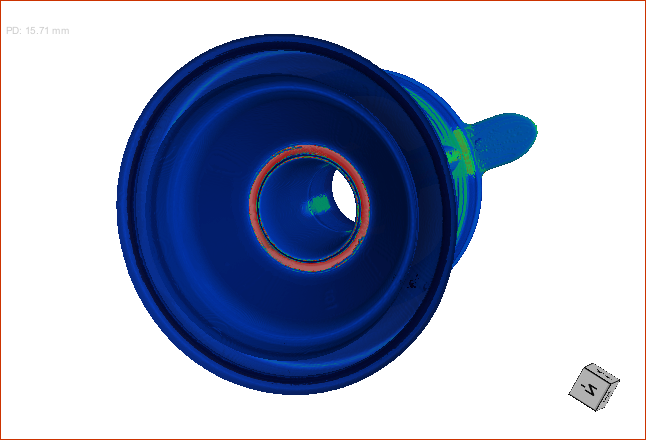
If the two surfaces containing the intersection points are not parallel, then the thickness values computed at the two opposite points will be different depending on the ray direction. This may lead to conflicting results for the pair of points.
You can also export regions of interest as thickness meshes, in which case thickness is determined through inscribed spheres (see Exporting ROIs and Multi-ROIs to Thickness Meshes).
How to Compute Ray-Tracing Thicknesses
- Do one of the following:
- Right-click the mesh in the Data Properties and Settings panel and then choose Compute Ray-Tracing Thickness in the pop-up menu.
- Right-click the mesh and then choose Compute Measurements in the pop-up menu.
Select Ray-Tracing Thickness in the Compute Measurements dialog and then click Compute.
The measurement 'Ray-Tracing Thickness' is computed and is selectable in the Scalar information box (see Scalar Information).